Saturday, December 3, 2011

11.22.11 Winogradsky Column Observations- Thanksgiving Edition!


11/22/11

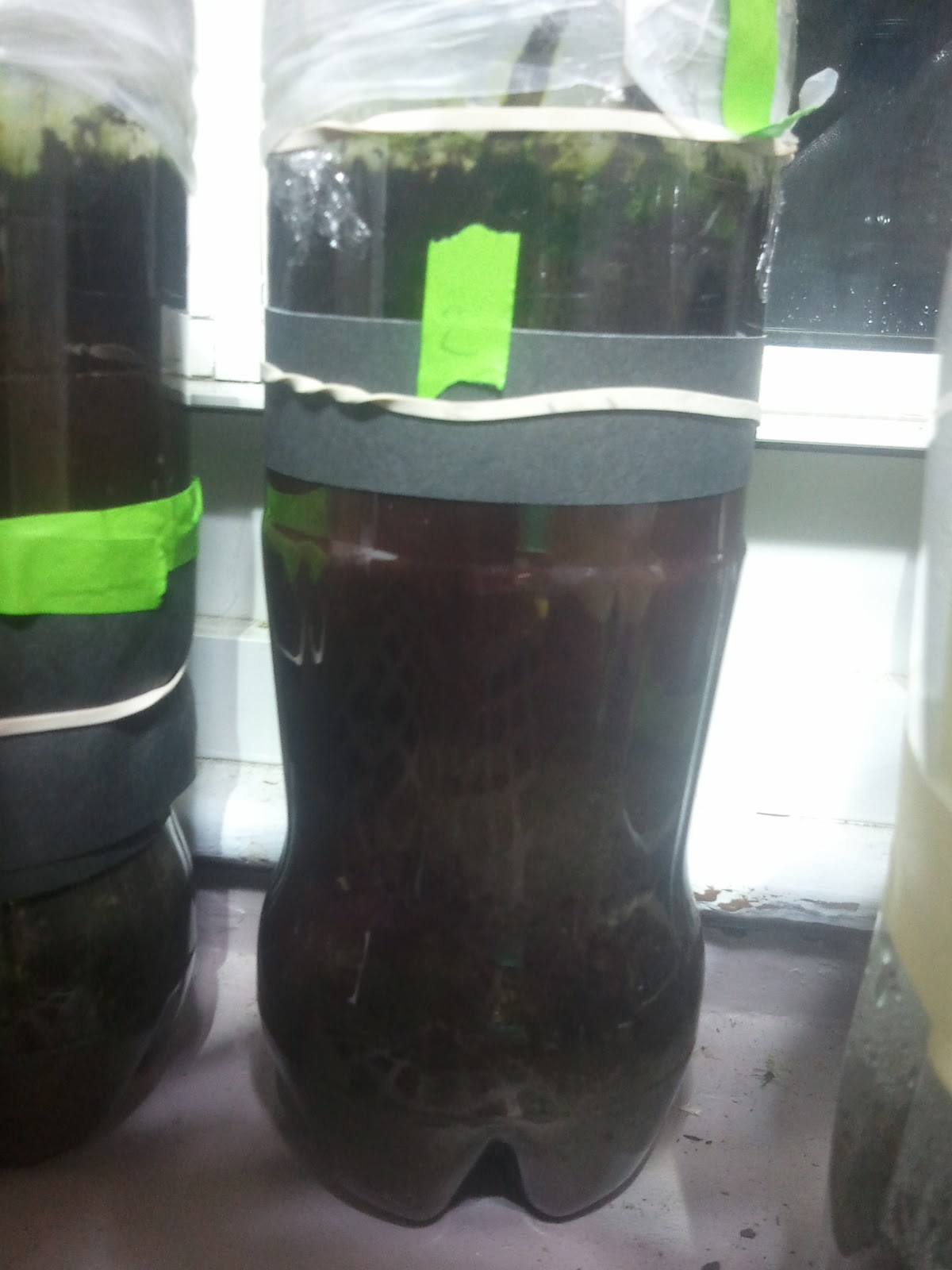
top view: all columns dark green, bottom occlusion is darker on top (richer phototrophic layer)


control: purple patches near bottom layer (purple s development)

no green s development yet

middle occlusion: no purple patches near bottom layer (devt of purple s layer not happening) bottom layer looks gray and drab, anaerobic sediment  weak or not developing


top: dirt layer rich and dark, purple patches developing well (purple s), rust layer larger than others

bottom occlusion: no rust colored layer (rest have it, what does this suggest) deep purple layer larger than rest (strong purple non s devt?), anaerobic layer covered but purple patches coming in near bottom (purple s).

Monday, November 28, 2011

11.17.11 Winogradsky column pictures/observation‏s


Control occlusion column: has still the largest magenta color.

Top occlusion column: has dark reddish color. During the time, its layer became more clearly visible and green s bacteria developing well.

Middle occlusion column: has less reddish color than the top occlusion. Has some red bacteria’s in the mud. No more white particles.

Bottom occlusion column:has the darkest magenta-black color and well developing photosynthetic & purple non-S & S and green S bacteria.

Extra note :Giant Winogradsky Column from Barcelona museum:

Wednesday, November 9, 2011

11.3.11 WInogradsky Column Pictures and Observations


Observations and analysis Week 4.

All columns appear to  show intense development of both purple non-S bacteria and purple S bacteria in anaerobic water. It is hard to compare each occluded column with the control one without disturbing its environment; therefore the final conclusion will be made during the last observation, when the cardboard is taken off the bottles. Nevertheless, during the forth week besides purple bacteria intense development in each bottle, there appears to be green S bacteria underneath. There is no evidence of bubbles (Hydrogen Sulfide gas) anymore, as it has all been consumed by non-aerobic bacteria breaking organic matter down. No foul odor either.  The most intense odor was during the first two-three weeks.
1.      The top occluded bottle: this bottle shows better development of green S bacteria underneath the purple S bacteria than the control one. Furthermore, photosynthetic aerobic bacteria is supposed to show less growth according to our hypothesis, nonetheless it develops very well on the water surface as well as in the top layer. Less intense purple color in the middle of the bottle.
2.      The middle occluded bottle: there is the same intense purple color, as in the control one. No access to see the S bacteria underneath. The top layer is well developed.
3.      The bottom occluded bottle: the same development of photosynthetic bacteria on top as well as purple non-S, S bacteria, and green S bacteria. There seems to be no difference between the control bottle and this bottle.

Things to consider: our columns are located right on top of the radiator. Since the weather is getting colder, the radiator started working and heats the columns and the room. Does increase in temperature stimulates the bacterial growth?

The Gradients Explained

Much has been made on this blog of the oxygen and hydrogen sulfide and aerobic/anaerobic gradients  of a Winogradsky Column. Some explanation may be necessary.


Source: Schematic view of a typical Winogradsky Column. Image credit: Jim Deacon, University of Edinburgh

This image above lays out the layers that develop in a Winogradsky Column. Our control column should develop along these lines. Our controls shoud disrupt this development nicely.


 Source: http://www.personal.psu.edu/faculty/j/e/jel5/biofilms/winogradsky.html (the author of the image is unfortunately not credited).

This image lays out the aerobic/anaerobic zones, a 40-60 split, respectively as well as the oxygen and hydrogen sulfide gradient. We expect a nice disruption of this gradient too. A note should also be made about the Green and and Purple Sulfur bacteria layers. They engage in a form of photosynthesis where hydrogen sulfide serves in the place of water in a typical photosynthetic reaction. More on this in  a later post.

Hypothesis Analysis


1. Is it original research, and how so?
As of yet, we have not seen any Winogradsky experiments relating to light occlusion


2. What exactly is your hypothesis? Do you have a prediction?
The hypothesis is that light occlusion should have marked effects on the development of the hydrogen-sulfide/oxygen and aerobic/anaerobic gradients of the column. In particular, the top occlusion is expected to create a more abundant levels of hydrogen sulfur anearobes and sulfuric aerobes. The middle occlusion should disrupt the development of the sulfur based bacterias  and non-sulfur based (purple-s bacteria, green s bacteria, and purple non-S bacteria).

The bottom occlusion will most likely not effect the development of the other layers mainly because the bottom layer does not require sunlight to develop effectively, much like the bottom of the pond at Prospect Park, the source of our dirt and water.

3. Besides gaining some knowledge, can the data collected be used to some end practically?

I think there may be a practical application to light occlusions if the top layer occlusion manages to disrupt aerobic activity effectively. One can imagine if there is a desire to increase the sulfur content of a body of water (to spur sulfuric microbial activity and ecosystem development because where there is protein, is not far behind), one can imagine the reduction of light absorption at the top layer of a freshwater pond becoming a viable method for spurring desired microbial activity. Perhaps a protein source can be provided to such a body of water which would break down into a sulfur source, the light occluded, and a desired microbial environment could be created. This light deprivation to produce desired bacteria may be useful in bacteria based environmental remediation efforts.

Monday, October 31, 2011

10.27.11 Winogradsky Column Pictures and Observations


Observations and Analysis:

All of the columns have developed a large, deep purple/magenta color in roughly the same section, the middle of the column. However, the control's magenta colored area is largest in size. The middle occlusion column (first photo) appears to have a darker magenta color than the rest. This may result from the middle occlusion. Is the magenta layer the beginning of the purple-non sulfur bacteria region of  a fully developed column? If so, this would mean that above this layer, there are only aerobic bacteria developing. Below it sulfur bacteria and anaerobic bacteria would be developing.

Above the magenta layers, all columns appear to be developing a green moldy layer at the top (the photosynthetic layer-cyanobacteria) All of the occluded columns had bubbles when viewed from above (not pictured). The control layer does not have bubbles at the top. This suggests that all the occlusions maybe causing a greater deal of oxygen at the top of the columns. Does this mean the typical oxygen-hyrdogen sulfide gradient is becoming unbalanced?

Finally, the top occlusion column's green, moldy layer, has expanded above the occlusion. When the occlusion was originally placed, the top of the column was not visible. Unless the occlusion slipped from position ( unlikely as occlusion was securely in place when viewed on October 27th), this means that the upper layer of the column has expanded a half inch. The bacteria may be covering an expanded area above the water surface.

An issue to consider: a means to look at the winogradsky columns under the occlusion without disturbing the occlusion and being able to put it back on in the same place.